


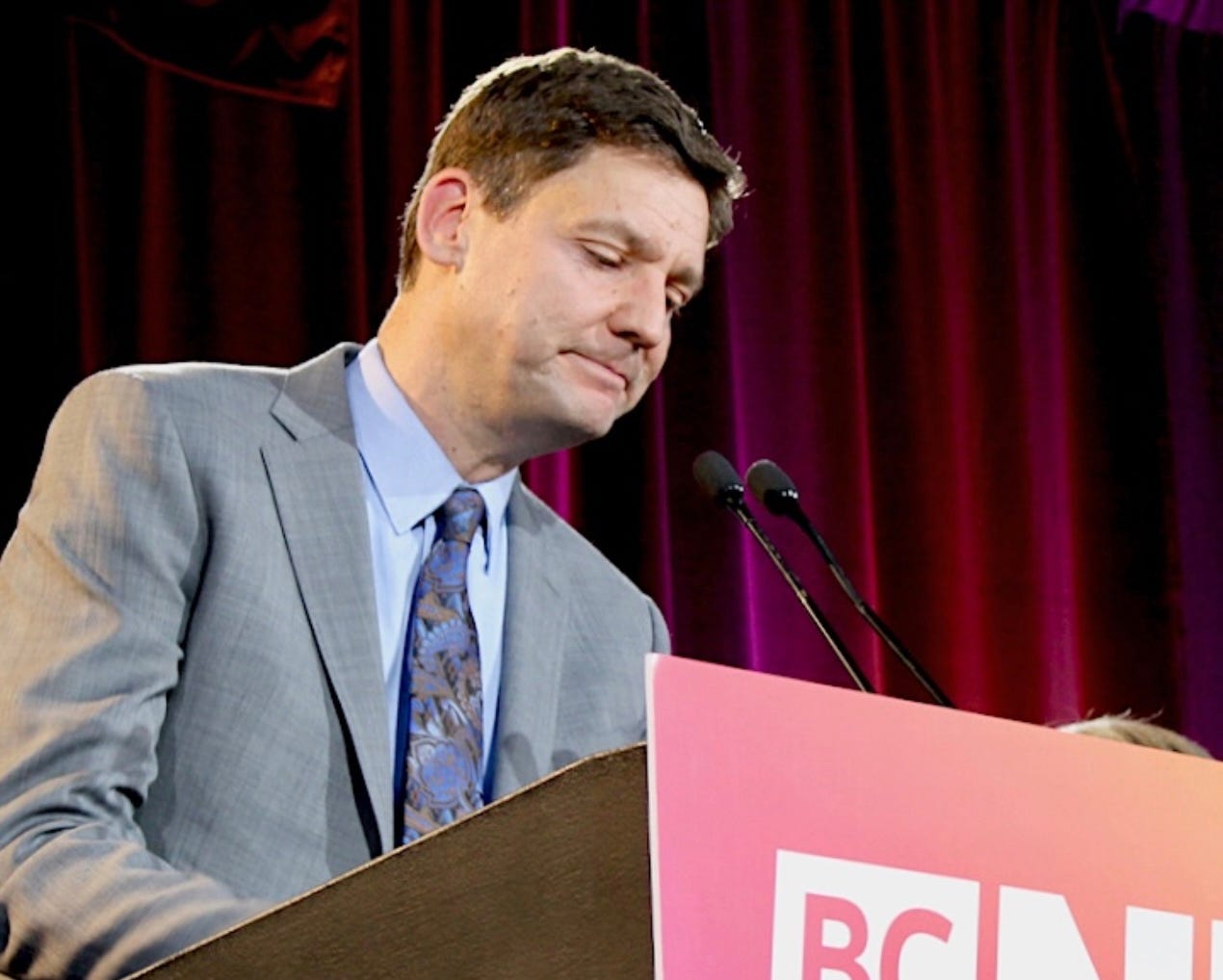
Despite his cerebral style, legal training and stern demeanour, former NDP Premier David Eby has always been a political juggler, a solo performer who kept throwing more balls in the air when catching a few would have been more impressive.
Until this year, it seemed to work. Eby’s personal approval consistently exceeded the party’s, even when most voters thought the province was on the wrong track.
Eventually, the act wore thin. The promised $1,000 grocery rebate? Can’t afford it. Province-wide $10 a Day childcare? BC’s fees are the worst in Canada. Quality public health care? The emergency room is closed.
Voters got bored, then annoyed. Worst of all, NDP supporters, feeling the pinch of a tough economy, began to wonder if Eby had forgotten what they came for. When they headed for the exits, Eby decided to grab their attention with a snap election, a grand finale political high wire act without a net.
The whole show came crashing down October 24 with the worst election outcome for the NDP in a generation, a loss of 19 seats in a single evening. The party was wiped out in critical areas like Surrey and the Fraser Valley, where the future of the province is being built. Eby resigned as Premier and party leader.
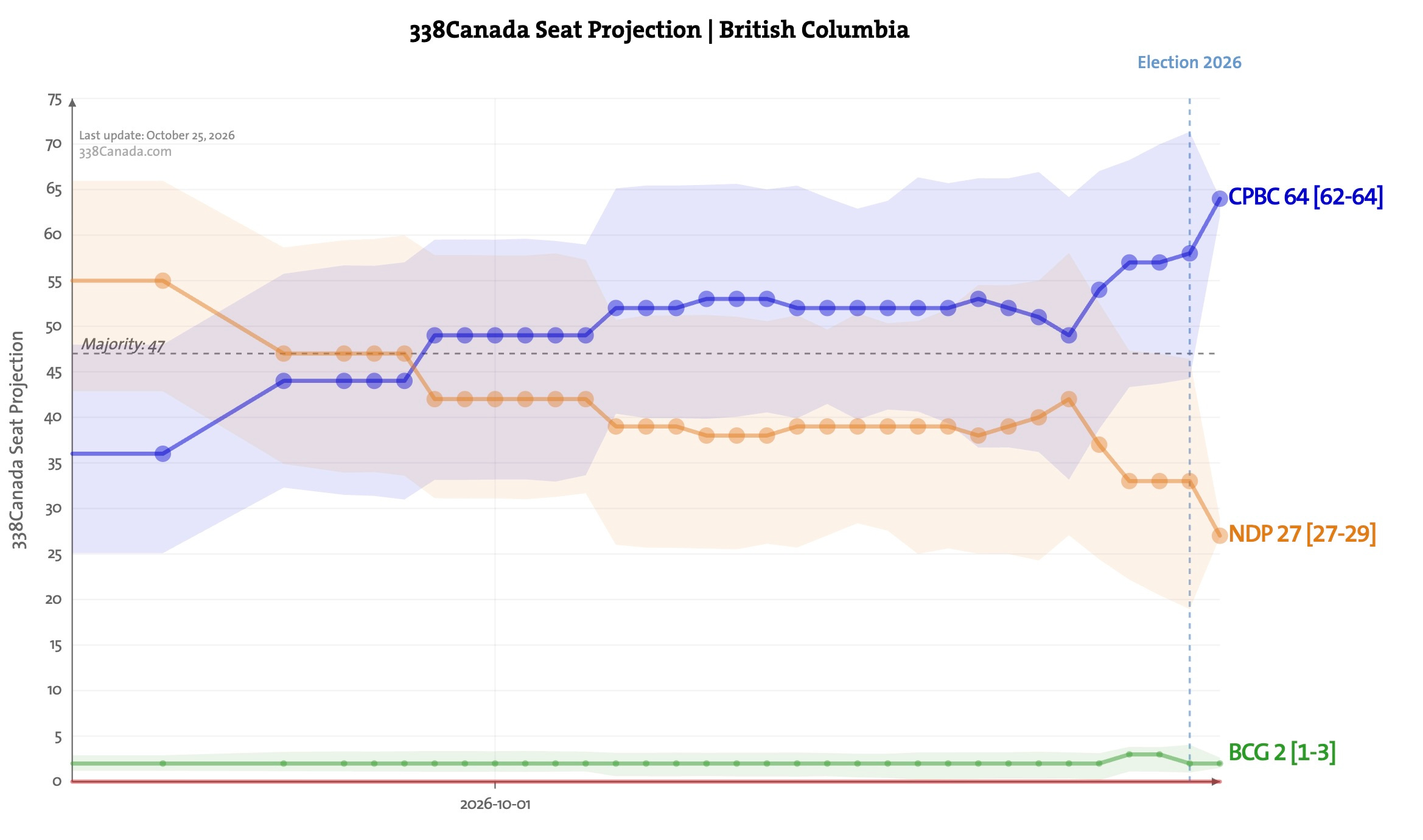
Eby’s snap vote with two years left in his mandate opened the door to the outcome he said he most wanted to avoid: a Conservative majority. (At the time of writing, Elections BC had declared the Conservatives elected in sixty-three seats, the NDP in twenty-eight and the Greens in two.)
While the NDP vote did not collapse -- the party won 37 per cent of the popular vote -- 200,000 to 250,000 NDP voters from 2024 either stayed home or voted for other parties. McAllister Opinion Research estimated that of every 100 people who voted NDP in 2024, ten voted Conservative this year, six voted Green, two voted for another party and eight stayed home.
Stay-at-home voters exceeded the margin required to elect a New Democrat in six seats. Five ridings had enough NDP-to-Green switchers to exceed the party’s margin of defeat in those seats. In the lowest election turnout in BC post-war history, key NDP voters sat it out.
The losses included many current and future leaders among the NDP candidates. Countless NDP legacies, like no-fault auto insurance and card-check certification, now are at risk. Tough battles loom ahead on Indigenous rights and title, affordability, the opioid overdose crisis, labour rights, women’s rights and child care.
At the Conservative victory party, newly minted Premier Lorne Doerksen exchanged exuberant hugs with former Premiers Gordon Campbell and Christy Clark, both erstwhile BC Liberals. (Remember the BC Liberals? They were the folks after Social Credit and before BC United, which collapsed into the BC Conservatives, all bound together by the common bond of “not the NDP.”)
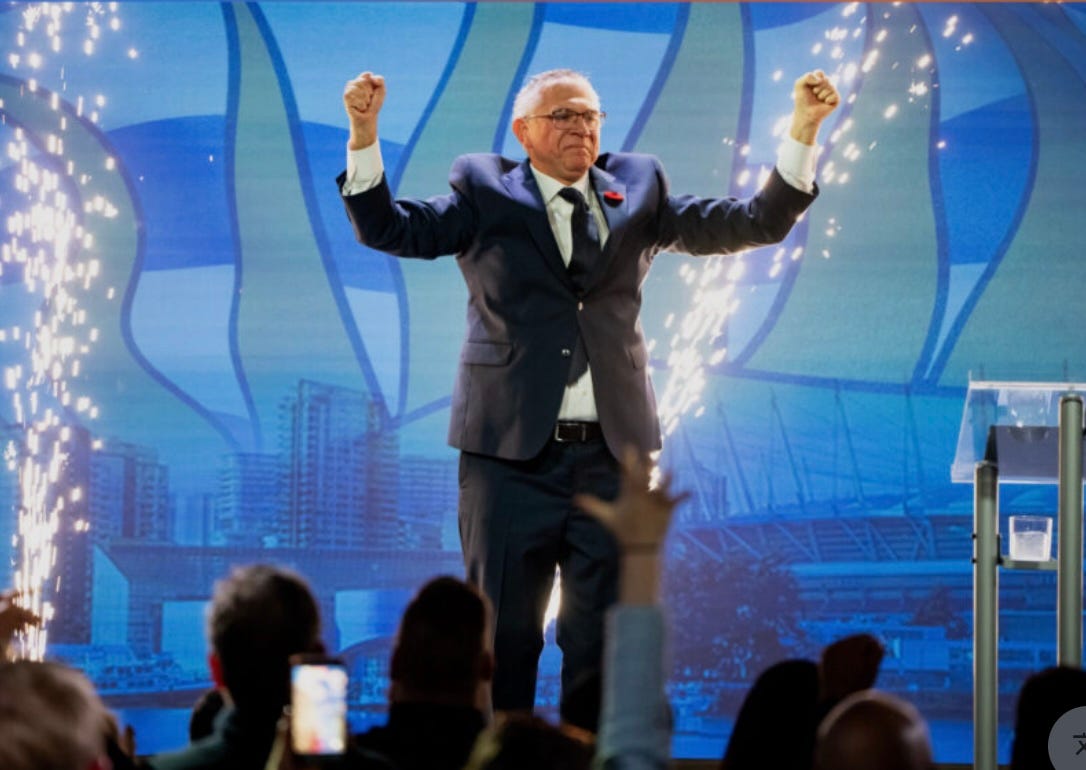
The incoming Premier has already laid down key markers for his legislative agenda: audit the books, slash taxes, “supercharge” the economy, make BC an “energy superpower,” repeal NDP housing legislation, end no-fault auto insurance, repeal the Declaration of the Rights of Indigenous Peoples Act and much more.
But what of the New Democrats? Now decimated and leaderless, will the party curl into the fetal position and let life take its course? Is there a quick way out of the political wilderness? If so, what could the post-Eby era look like?
While some New Democrats will be tempted to blame everything on Eby, the larger question is how a government with a two-seat majority allowed what looks in retrospect to be an act of collective suicide, triggered by the decisions of a single man.
The catastrophe began unfolding two years ago, incubating in the ashes of the near-death outcome of the 2024 election. Eby won a single seat majority, a seat that Surrey Guildford MLA Garry Begg held by only twenty-two votes. Although Eby won forty-seven seats, one member had to become speaker, able to cast a tie-breaker vote if required. On the opposition benches were forty-four Conservatives and two Greens.
In practical terms, a majority this fragile was not likely to last more than two years. What disguised its weakness was the chaos on the Conservative benches.
Despite a Confidence and Responsible Government Agreement with the BC Greens, Eby struggled to pass key legislation. Even two bills designed to fast-track economic development, including the Northwest Coast Transmission Line, came under heavy fire.
Although distracted by a growing internal crisis that would consume them, the Conservatives under John Rustad opposed the transmission line and worked to slow Eby’s other initiatives. As the Official Opposition, that’s their job. But Eby’s team also came under fire from Indigenous leaders, who had not been consulted on the fast-track legislation. Relations with First Nations began to fray.
Ultimately, Eby had to declare the Energy Statutes Amendment Act, Bill 31, a confidence matter to force it through the Legislature against the Conservatives and the Greens, who both opposed it for different reasons.
Although a speaker’s tiebreaker is expected for confidence votes, the Eby team began to use the tiebreaker on a regular basis to pass routine legislation, a sign of problems to come. Ultimately the NDP government used its tiebreaker option an astonishing thirty-two times.
The 2025 budget was another migraine headache. Just two weeks after introducing a budget with a record $10.9 billion deficit, Eby confirmed that BC would align with Mark Carney’s federal Liberals by cancelling the consumer carbon tax and the fuel tax, blowing another $1.6 billion hole in the bottom line. This huge tax concession, quickly obscured by oil industry price swings and profit-taking, went mostly unnoticed by consumers, but forced tighter austerity in other parts of government, like child care, that would have serious consequences.
Compounding Eby’s budget problem was a prolonged dispute with the BC General Employees Union (BCGEU), which secured a 93 per cent strike vote and then shut down the BC Liquor Distribution Branch to choke off an important revenue source to the government.
The seven-week strike was finally settled in mid-October with raises of three per cent a year in each year of a four-year agreement, well above the government’s goals of two per cent a year. The BCGEU settlement then rolled across the public sector like a multi-billion-dollar budget tsunami. Costly settlements to teachers and nurses soon followed.
Despite these woes, Eby came through the NDP’s biennial convention with a solid endorsement in a mandatory leadership review. Soon after convention, however, Eby’s already-difficult year took a turn for the worse.
The government was blindsided in August by the Cowichan decision. The long-awaited BC Supreme Court verdict upheld Cowichan First Nations claims that they had been fraudulently cheated more than a century ago of valuable waterfront land at the Richmond site of one of their historic villages. When Richmond Mayor Malcolm Brodie told local landowners their property could be at affected, Conservative voices launched a province-wide outcry over the alleged risk to fee simple private property.
That crisis accelerated in December with Eby’s angry reaction to the BC Court of Appeal’s Gitxaala decision, which held that BC laws must be aligned immediately with the UN Declaration on the Rights of Indigenous Peoples.
Fuming that the decision was contrary to the government’s intentions and would put “the courts in the driver’s seat,” Eby immediately declared his intention to amend BC’s Declaration on the Rights of Indigenous Peoples Act (DRIPA), putting his government on a collision course with the First Nations Leadership Council.
One of the proudest achievements of the John Horgan administration, DRIPA had passed the Legislature unanimously in 2019. Its provisions paved the way for unprecedented agreements with the Tahltan Nation to unlock critical mineral developments in the province’s Northwest. Now Eby proposed to act unilaterally to suspend or amend what had been hailed as a watershed in the struggle for reconciliation. First Nations leaders denounced his plans as a profound betrayal.
Whatever one’s view of the impacts of the court decision -- and they were not trivial -- this direct confrontation with vital partners was a sign of deep trouble in the NDP administration. The New Year brought no respite.
As the DRIPA battle escalated and Budget Day loomed, the province was blindsided by tragedy. A lone shooter in Tumbler Ridge killed eight, injured twenty-seven and then turned the gun on herself.
When Eby cancelled the 2026 Throne Speech to attend a day of mourning for the victims, it was evident his administration was more driven by events than directing them. When the Throne Speech itself was eventually released under a freedom of information request, it was clear the government had little new to offer.
The budget could not be cancelled. The government’s austerity efforts “re-paced” long-awaited hospital projects, and cut or eliminated small but cherished programs, but failed to reduce spending. It was a political loser both ways.
Finance Minister Brenda Bailey’s $13.8 billion deficit had barely faded from the headlines when the NDP spiralled into crisis over DRIPA. Determined to “fix” DRIPA, with or without Indigenous approval, Eby announced April 2 that he would force a confidence vote on his amendments that he was certain to lose.
That certainty became undeniable days later when Grand Chief Stewart Phillip announced that his wife Amshen, Joan Phillip, then fighting cancer from a Vancouver hospital bed, would vote against the amendments, ensuring their defeat. After a “tap on the shoulder “ from Attorney General Niki Sharma, Eby backed down on amendments and finally shelved them altogether.
This needless and tragic confrontation over one of the government’s most important legislative achievements, which pitted the Premier against a revered Indigenous member of his own caucus, sent shock waves through the NDP and its electorate. A snap election on the issue of DRIPA and Indigenous rights was only averted at the eleventh hour. This was clearly a government in desperate need of a reset.
Even the pandemonium among the Conservatives could not obscure the disarray on the government benches. The Conservatives had forced out leader John Rustad, split in several directions, held a leadership contest that resulted in a dead heat between Kerry-Lynne Findlay and Caroline Elliott, then resumed an internal war that produced a caucus meltdown. Through it all, the Conservative voter support remained remarkably competitive. By July they were four points ahead of the NDP with 44 per cent support.
On May 28, the legislative session staggered to a close. On July 3, a rare bit of good news: former Conservative MLA Amelia Boultbee, sitting as an Independent, crossed to the New Democrats. Eby had doubled his majority!
After such a rough session many Premiers would have paused to regroup, perhaps prorogued the Legislature, shuffled cabinet, rebuilt staff and began planning for an election. None of that happened.
Instead, mesmerized by a modest summer rebound in his polling and confident he could run roughshod over Kerry-Lynne Findlay and her battered caucus, Eby decided to go to the voters. By September 18, the wheels had been put in motion, but on September 20, the once-defiant “I’m not going anywhere” Findlay was gone.
Their minds focussed by the threat of electoral death, the Conservatives put aside their differences to focus on their common enemy, the NDP. Ladies and gentlemen, meet Mr. Lorne Doerksen, fourth leader of the Conservatives in less than a year!
Despite advice to the contrary, Eby pushed heedlessly ahead. It cost him his job. Within days, the NDP advantage vanished, the Conservatives pulled ahead and they never looked back.
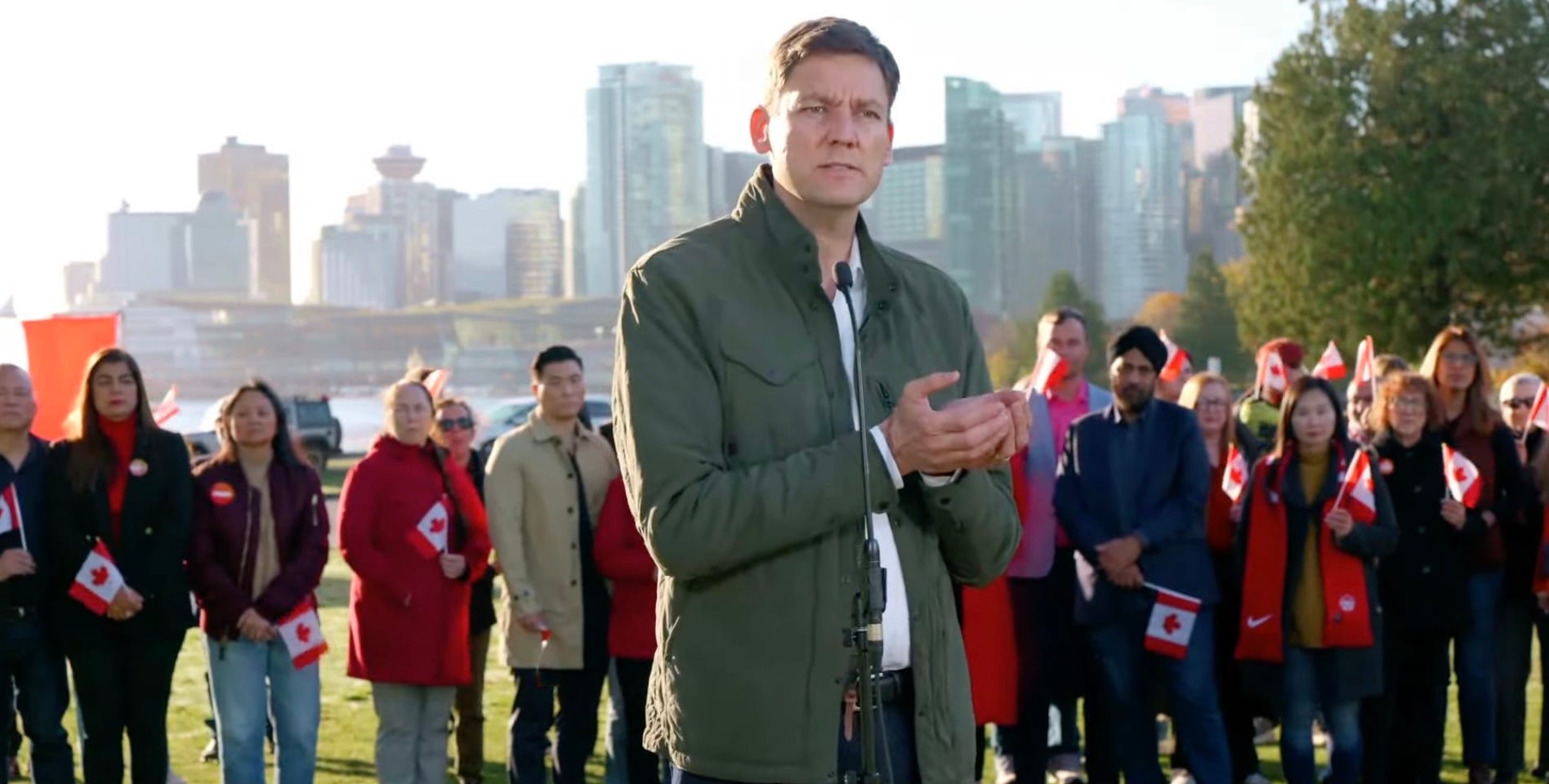
The late summer recovery of Eby’s popularity, coupled with the chaos in the Conservative Party, was a sound reason to consider an election on purely tactical grounds. But what was the rationale? Was the party ready? What mandate was the government seeking? Eby could never define one.
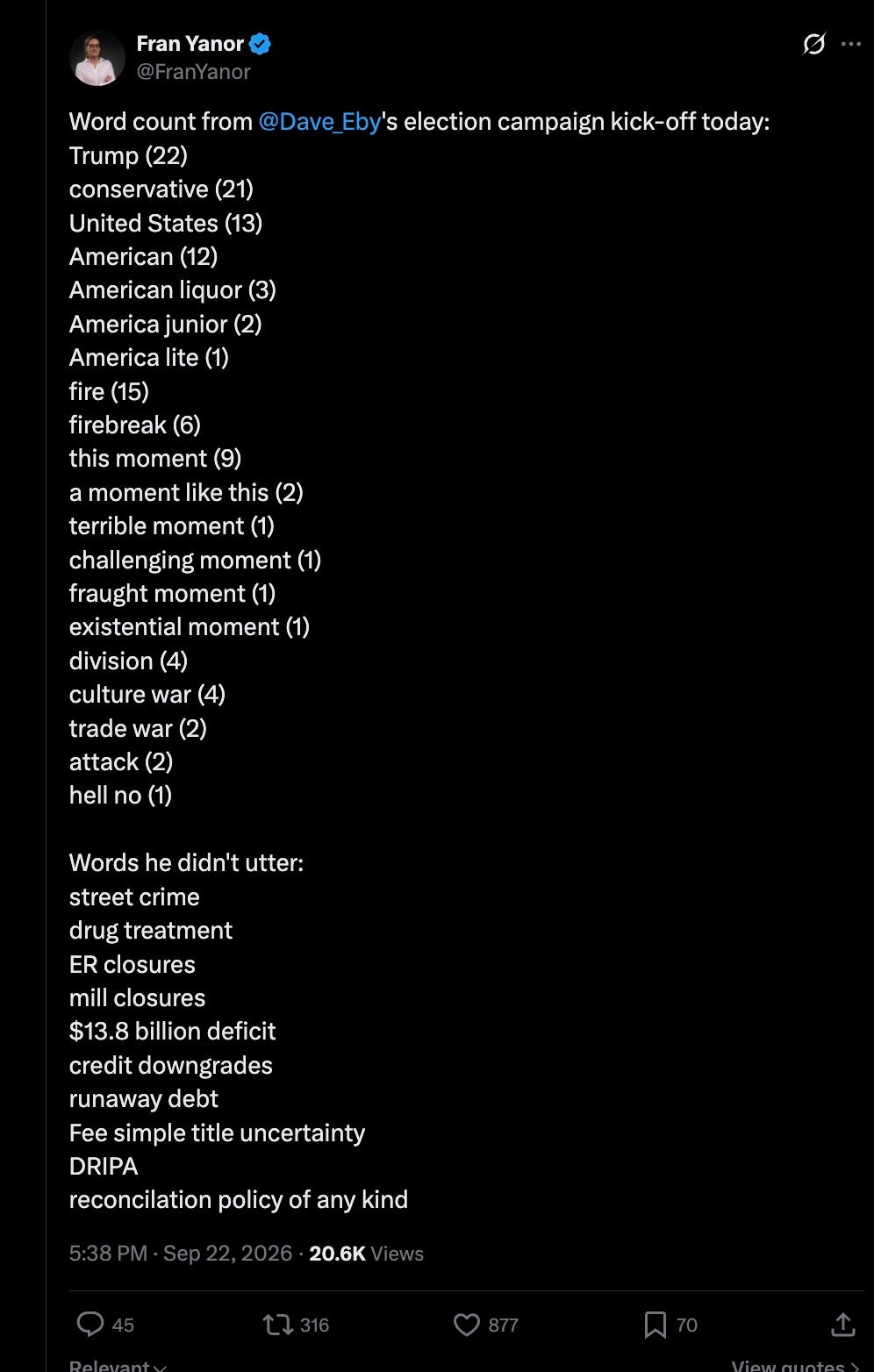
The campaign careered from the “existential moment” posed by Trump tariffs to the fight for affordability and finally to the government’s need to end the misery of a one-vote majority. None of it appealed to voters, many of whom sat this one out.
Like the juggler he is, Eby kept throwing balls in the air -- regulated grocery prices, a “millionaires’ tax,” controls on gas prices, Urgent Primary Care Centres in every town -- without offering a campaign narrative. “I’m not perfect,” he admitted, but that hardly constituted an acknowledgement of voter anger. The revelation of his children’s attendance at a $10 a day child care knocked the air out of the campaign for days.
What was the cabinet and caucus view? Did the party executive or provincial council weigh in? When a critical condition for victory disappeared with Kerry-Lynne Findlay’s resignation, was Eby left to make the final call on his own?
How did the government, especially the Premier, become so isolated from daily voter concerns? John Horgan built his 2020 majority by winning new supporters in suburban ridings across the south Fraser all the way out to Abbotsford and Chilliwack. What will it take to win those areas back?
The NDP’s members are entitled to answers to these questions, if only to avoid such debacles in the future. Had the NDP’s 2024 supporters all come out to vote, the opposition caucus could have been fifty per cent larger.
Dire as the results were for the NDP, there are strongholds to build on. Even when the tide was running against him, a capable candidate like Will Cole-Hamilton in Courtenay Comox was able to pry a seat away from an incumbent Conservative who had cabinet ambitions. In Kelowna Centre, a “not NDP” riding if there ever was one, Loyal Wooldridge came within 132 votes of victory before mail ballots were counted.
Rebuilding is hard work but rewarding. Four years after Gordon Campbell’s Liberals reduced the NDP to two seats in the 2001 election, Carole James won thirty-one additional seats to restore the NDP to contention. John Horgan eked out a minority mandate in 2017 and governed for three years through a Confidence and Supply Agreement with the Green Party. His snap election, held four years to the day before Eby’s, produced an NDP majority of fifty-seven seats, a gain of sixteen.
An election review process can help lay the foundation for future success. Selecting a new leader will be part of that process, but should be seen as part of that renewal, not a substitute for it. Fortunately, there are a number of excellent candidates who may be prepared to serve.
During his concession speech, Eby recalled the 15-minute drive from his westside home to the election night headquarters.
He passed the Broadway Skytrain extension, now near completion; then one of the 250 new schools built during the NDP’s nine years in power; then St. Paul’s Hospital, now opening a new $2.2 billion facility; and countless small businesses, where workers now have the highest minimum wage in Canada, not the lowest, as they did in 2017.
All were legacies of the Horgan era. None was mentioned during the campaign, as Global commentator Jas Johal noted on election night.
Even the $30 billion decision to proceed with LNG Canada’s Phase 2 expansion, announced during the campaign’s first week, was never mentioned again, although it is the largest private sector investment in Canadian history. The commitment to Phase 1, of course, had been a signature achievement of Horgan’s first term.
Those legacies, never part of the 2024 campaign, were a big reason for Horgan’s success in 2020. Perhaps more of those kinds of initiatives, announced and then executed, would have saved Eby’s team from disaster.
“This was not the result that any of us wanted,” Eby said. “It breaks my heart and I accept full responsibility for that outcome . . . It’s time for new leadership in our party.” That new leadership, whoever it is, has a big hill to climb, but it’s been done before.
For two other perspectives on the NDP’s election loss, see Jennifer Howard’s No One Knows Anything About Politics on No Little Dreams, and Ron Johnson’s We Must Build A Renewed BC NDP From The Bottom Up, both on Substack. Howard served as cabinet minister in several Manitoba NDP administrations and was chief of staff to Jagmeet Singh. Johnson is a lifelong activist in the BC NDP, a onetime candidate and a former communications strategist for NDP campaigns and governments in four provinces.
Thank you Geoff - your knowledge of and past role in the upper reaches of government make this all the more depressing and avoidable. 🤕
Thanks for sharing this in such an eloquent way.